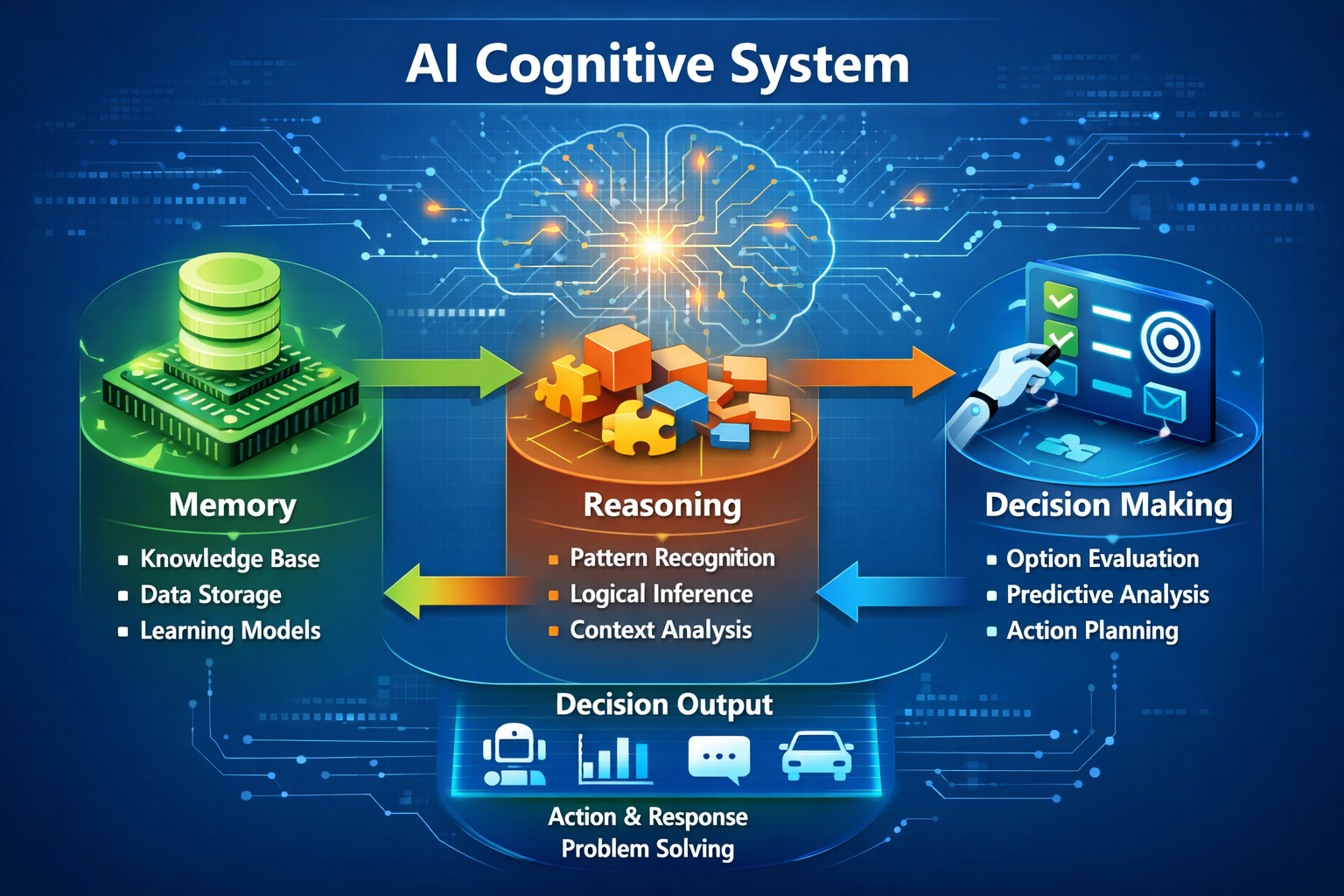
The development of artificial intelligence is quickly shifting away to agentic systems of artificial intelligence and away from passive models – intelligent systems which can reason, plan, remember and take action independently. The main part of this change is cognitive architecture, a systematic outline that allows the AI agents to imitate the way a human being thinks. They are not simply architectures concerning processing data, but rather architectures that are capable of learning through experience, evolving over time and making autonomous decisions in complex environments.
What Are Magnetic AI Cognitive Architectures?
Cognitive architectures specify the organizational structure of an AI system giving it a perception system, reasoning, memory and action system. These architectures act as the guide towards constructing the self-directed systems in agentic AI which can be run with very small human involvement.
basic building blocks of Cognitive Architectures.
Cognitive architectures usually consist of a number of modules connected with each other that collaborate in a seamless manner to mimic human cognition. The perception layer assists the system to read the inputs of the system including text, pictures and the environmental cues so that the system can comprehend the environment. Memory systems save information both short-term and long-term and allow the AI to remember previous interactions and become better as time goes by. The reasoning engine is in charge of data analysis and making rational choices, whereas the planning module divides the goals into systematic steps. Lastly, the action interface makes sure that the correct decisions are implemented, be it in digital systems or in real-life scenarios. These elements can work together to help AI agents to observe, think and act wisely in dynamic scenarios.
Characteristic AI Systems of agents.
- Autonomy- Works without being under human supervision.
- Goal-Oriented Behavior – Is concerned with the accomplishment of the set goals in an efficient manner.
- Context Awareness- Is aware of what is going on in the environment and adjusts to it.
- Continuing Learning- Enhances performance due to the continuous experience and feedback.
- Multi-Step Reasoning – Solves problems that are complex; thinking logically in steps.
Why These Characteristics are Important.
All these characteristics make AI to be more of an intelligent tool rather than a mere automation mechanism that can be used to perform complicated work flows. The independence also minimizes the human factor that can make businesses expand their operations effectively. Goal-seeking behavior makes AI systems have focus and productivity whereas context awareness enables them to respond to changes in real-time. The ability to continuously learn allows long term enhancement of the systems of accuracy and reliability. Multi step reasoning is applicable to areas such as research, finance and strategic planning since it is able to address issues that need further consideration.
Intelligence based on Memories in AI Architectures.
Memory is an important element that takes AI to a new level of being reactive to proactive. Learning and evolution of systems are impossible without memory.
Memory types in AI Systems.
The AI memory systems are modeled to reflect the human cognitive memory systems, enabling machines to be able to store and recall information effectively. Working memory or short-term memory is a memory that deals with immediate tasks and immediate data processing allowing real-time responses. Long-term memory forbears previous knowledge and patterns learned, thereby allowing the enhancement of AI systems as time progresses. Episodic memory captures particular events and interactions and is used to give context to the decisions in future. Semantic memory is concerned with structured information, facts and relationships, which assist the system to interpret and comprehend information correctly. Combined, these types of memory help AI to provide more personalised, contextual and intelligent responses.
Self-Arguments and Decision Making Processes.
The characteristic of agentic AI is self-reasoning. It enables the systems to analyze the situations, explore alternatives and make decisions which are informed.
Self-Reasoning techniques.
Self reasoning in AI is a process that has several advanced methods that allow analysis of the problem. Chain-of-thought reasoning enables the system to divide complex problems into small steps which can be handled thus enhancing accuracy and clarity. Exploration using trees can be used to determine various potential solutions that can be used and then the best one is chosen. Feedback loops are very important as it enables the system to learn on the basis of the results and better the future decisions. Moreover, the integration of tools allows the use of external resources by AI agents, including APIs and databases, which allows them to address real-world problems better. All of such methods enable the AI systems to imitate a human-like way of thinking and decision-making.
Designing AI Systems that are autonomous.
- Modularity- allows each part to be independent, but work together.
- Scalability- Supports increase in data, user and complexity.
- Robustness -Stands up to uncertain or changing conditions.
- Explainability – Makes the decision making processes transparent.
- Safety Controls – Averts undesirable or detrimental system behaviour.
Real-World Applications
Use Cases
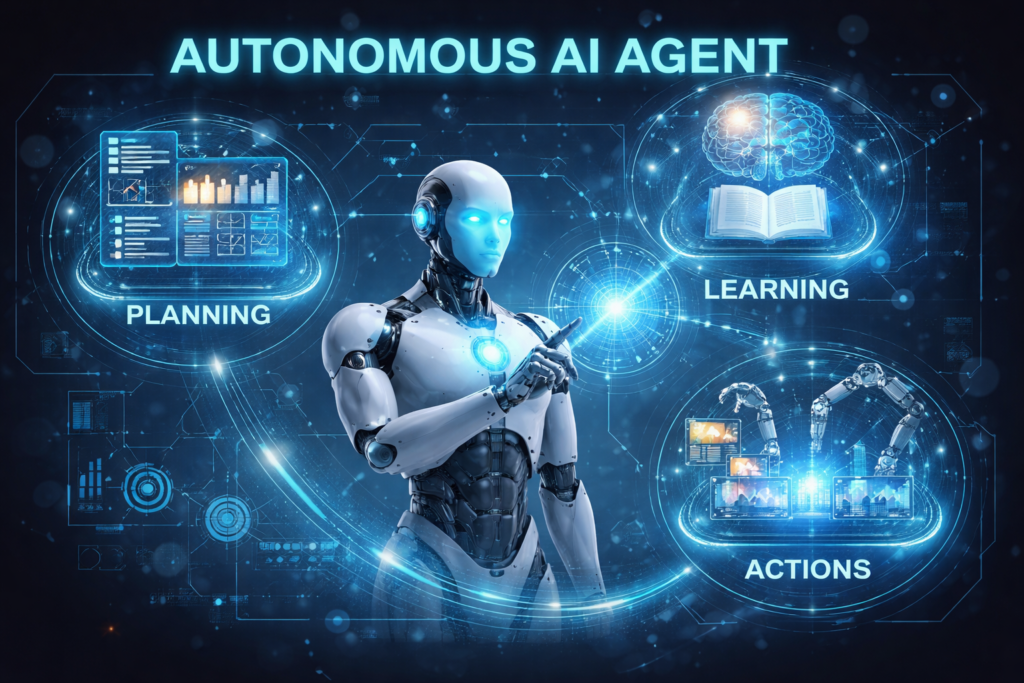
Smarter and more efficient operations are also being facilitated by agentic AI that is driven by cognitive architectures and is changing the operations of various industries. Autonomous AI assistants are able to process large volumes of data and provide insights in a short period of time in a research. These systems, in business automation, simplify workflow and streamline and optimise decision making. Personal AI assistants are getting more advanced, with specific suggestions and assistance according to user actions. AI systems used in the healthcare sector aid physicians and give diagnostic information and treatment recommendations. Available financial institutions make use of agentic AI to examine the market tendencies and inform investment choices. These applications show the development of AI systems towards intelligent agents capable of acting independently.
Conclusion
The next generation agentic AI systems are based on cognitive architectures. Combining memory, reasoning and autonomous decision making, these systems transcend the classic AI models to produce intelligent agents that can act autonomously. With the ever-evolving technology, these architectures will be instrumental in defining the future of AI to make the systems more powerful, as well as more adaptive and reliable. Although there are still issues to address, continuous developments have slowly enabled us to have a closer look at a world where AI systems serve as intelligent partners to deal with challenging real-world issues.
Most of the time, Frequently Asked Questions (FAQs) are employed.
1. What is agentic AI?
The term agentic AI includes the systems that are able to act on their own and make decisions and pursue goals without being overseen by a human.
2. What are the reasons behind the importance of cognitive architectures?
They give the framework required to make AI systems to think, remember and reason like humans.
3. What is the contribution of memory to the performance of AI?
Memory enables AI to learn through past experiences, and make more accurate and context-sensitive decisions.
4. Which industries are the most beneficial of agentic AI?
Some of the best industries that have benefited with such systems are healthcare, finance, research and business automation.
5. What are the largest problems in the creation of agentic AI?
Critical issues are scalability, accuracy of reasoning, ethical issues and effective memory management.