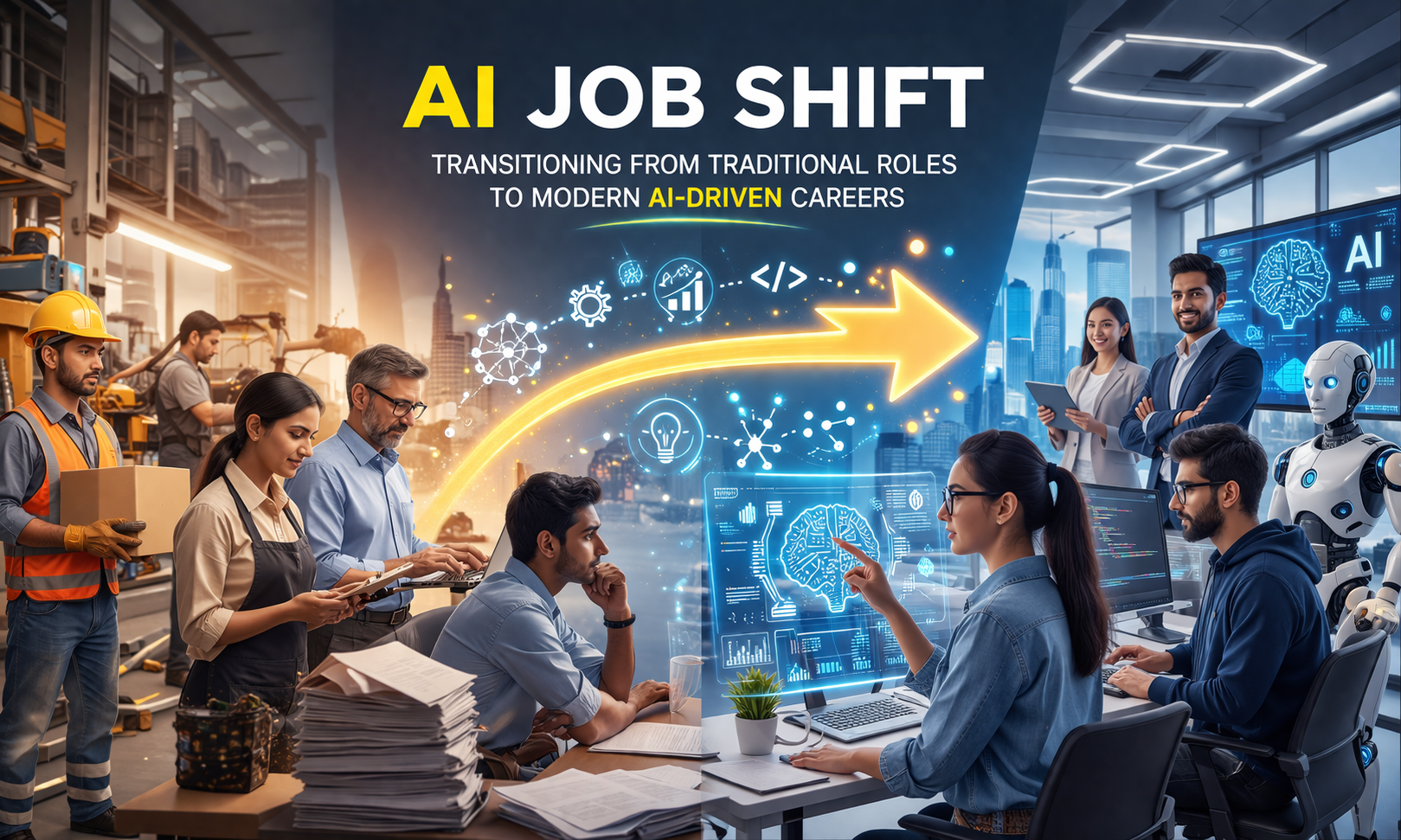
Artificial Intelligence (AI) is a phenomenon that has developed very fast as a futuristic concept to become one of the forces that will determine the world workforce in 2026. Companies in all industries are adopting AI as part of their day to day business activities to enhance efficiency, cost reduction and competitive advantage. This has brought about a significant discussion: Will AI kill or bring about new jobs? The reality is less black and white. AI is not only about the extinction of jobs, but it is altering the whole landscape of employment by doing away with some jobs, introducing new ones, and changing the way current jobs are done.
Replaced Jobs AI is Replacing.
Routine and Repetitive Roles.
AI is specifically efficient at dealing with structured and repetitive tasks, as well as those that are based on rules. Consequently, employment in fields like data entry, simple customer service, telemarketing and manufacturing is slowly fading. These can be done at a cheaper cost, more precisely, and faster by machines making them an appealing substitute to the businesses.
But this does not imply that the whole profession is being wiped out in one day. Rather, certain functions of these jobs are being automated which means that there is a gradual change as opposed to an abrupt substitution.
Why These Jobs are at Risk.
The key consideration that is putting these jobs in danger is their predictability. AI systems are created to be able to learn patterns and perform tasks on the basis of data. The job is more automatable when there are straightforward rules and little variation. Solutions that enhance productivity and minimise human error are naturally gravitated towards over time since the business is driven to those solutions and hence the first position to suffer is this role.
Jobs AI is Making.
Roles of AI.
As much as AI is taking over some duties, it is also generating new job categories never before witnessed in several years. Such positions as AI engineers, machine learning specialists, data scientists, AI ethics experts, and automation consultants are now in demand. These experts will design, operate, and enhance AI systems which operate contemporary businesses.
Moreover, businesses are becoming more invested in AI infrastructure, and it is providing possibilities in the fields of research and development and system integration. These are more specialized jobs, which involve both technical expertise and strategy.
The emergence of hybrid jobs.
The other significant trend in 2026 is the introduction of hybrid jobs. AI is not replacing humans, but rather improving their abilities. To use AI as an example, marketers can apply AI technology to study customer behavior, doctors can make diagnoses more quickly and accurately, and teachers can tailor learning experiences.
These ambivalent positions indicate an important change: it is not the human and the machine that will be opposed in the future, but the cooperation. Individuals with the skill to utilize AI tools are increasingly becoming valuable in the job market.
The Skills Shift 2026: What Counts.
Change Adaptation.
With the current development of AI, the skills demanded in the labor market are also varying. The traditional skills are not sufficient any longer. The professionals should be ready to change, acquire new technologies, and constantly improve their knowledge. Flexibility and an openness to change has become one of the most valuable attributes in the current job market.
The Skills You Will Require in an AI-Driven Future.
- Rational thinking and problem solving skills to deal with complex problems.
- Innovation and inventiveness to come up with new concepts, which the AI cannot imitate.
- EI to be a good communicator and leader.
- Simple technical knowledge of AI tools, data and digital systems.
- Flexibility to align with the fast evolving technologies and work conditions.
- Lifelong learning and commitment to skills development.
The Indies that AI will have the greatest influence on.
Automation-Focused Sectors
Manufacturing, retail, banking, and logistics are among the industries that are undergoing tremendous change as a result of AI. Through automation, operations are being simplified, manpower being minimized as well as efficiency is being enhanced. This will result in job displacement in certain regions but it will also give the workers the possibility to move to higher jobs.
HGrowth-Oriented Sectors
Conversely, the growth of such industries as healthcare, AI development, renewable energy, and digital marketing is high. These areas are being innovated with the help of AI, which is why more professionals are demanded. These industries are not merely surviving the AI revolution, they are flourishing due to the AI revolution.
The Human Benefit of the AI World.
AI Can Replace Nothing.
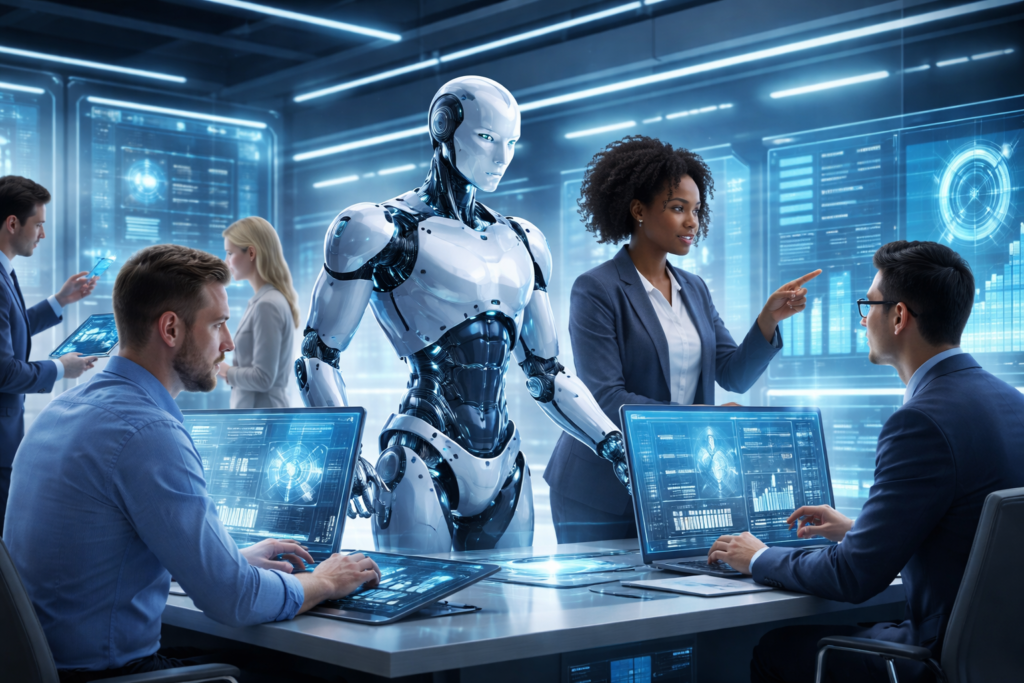
Although it has gone through rapid developments, AI is also limited. It is unable to completely recreate human empathy, creativity, ethical judgment and capacity to cope with complicated social circumstances. These distinctly human attributes are also imperative in most careers and most specifically those that touch on leadership, care and innovation.
Teamwork, not Competition.
The best organizations in 2026 will be those that will not consider AI as a competitor but their partner. Human intelligence and machine efficiency can be combined in order to get better results in businesses. This is a team-work solution that is reshaping the future of work and providing a more balanced and a more productive environment.
Conclusion.
AI is not appropriating jobs, it is transforming the nature of work. Resisters of change might struggle to keep up, but those ready to accept AI and constantly train their skills will be able to find new and exciting opportunities. It is those who will be able to integrate human creativity and AI abilities and succeed in a fast-paced world who will have a future.
FAQs.
1. Is the end of human jobs upon us?
No, AI will not only automate certain functions but will also invent new positions and will change the current jobs, making the workforce more advanced.
2. What are the safest jobs that AI will not be able to take over?
Less likely to be fully automated are jobs which demand creativity, emotional intelligence, and decision-making processes of a complex nature.
3. What can I do to prepare for AI-driven jobs?
To prepare, you can learn new technologies, practice solving problems and be flexible through ongoing learning.
4. Is AI destroying more or fewer jobs?
The use of AI in various industries is opening up new opportunities, but there are jobs that are being eliminated or reshaped.
5. Which industries will see the greatest increase as a result of AI?
There will be a major increase in healthcare, AI development, renewable energy and digital services.